- Home » Solutions »
- MRO Management
Built for the Hangar. Powered by Tech.
Built by Experts. Engineered for the Hangar.
Key Modules and Capabilities
Customer Management
Smart Contracting
Define the scope of work with clear contract terms. Link contracts to specific aircraft types, work types, or operational ranges. Establish pricing rules-fixed rates, time & material, or custom quotations-and auto-generate invoices based on these pre-set rules.
Check Plan Templates
Create standardized check plans by defining phases, sub-phases, and estimated labor resources. Include non-routine Cards for more accurate planning. These templates form the backbone of recurring check types such as A, C, and D checks—or task-based programs defined by OEM maintenance requirements.
Sales & Quotations
Generate tailored quotations for clients and convert them directly into sales orders. Automatically create associated check work orders upon approval, ensuring a smooth transition from proposal to execution.
Check Work Orders
The heart of AircraftCloud MRO, it allows you to import maintenance tasks from your Maintenance Program or external files. Allocate tasks across check phases, link labor, tools, and parts, and calculate the total capacity required by skill and trade.
Component-Specific Maintenance
Assign tasks to specific components and track lifecycle metrics such as flight hours, flight cycles, aircraft time, and calendar-based intervals. This ensures precise tracking and complete audit trails.
Phase Check Management
Structure checks phase-wise (e.g., 1A, 2C) for better execution planning, resource forecasting, and progress monitoring. Allows granular control over task distribution and sequencing.
Parts & Tools Management
Automatically calculate the required tools and parts for each check phase. Material requirements are linked to scheduled dates, ensuring timely availability and reduced downtime.
Rostering & Planning Boards
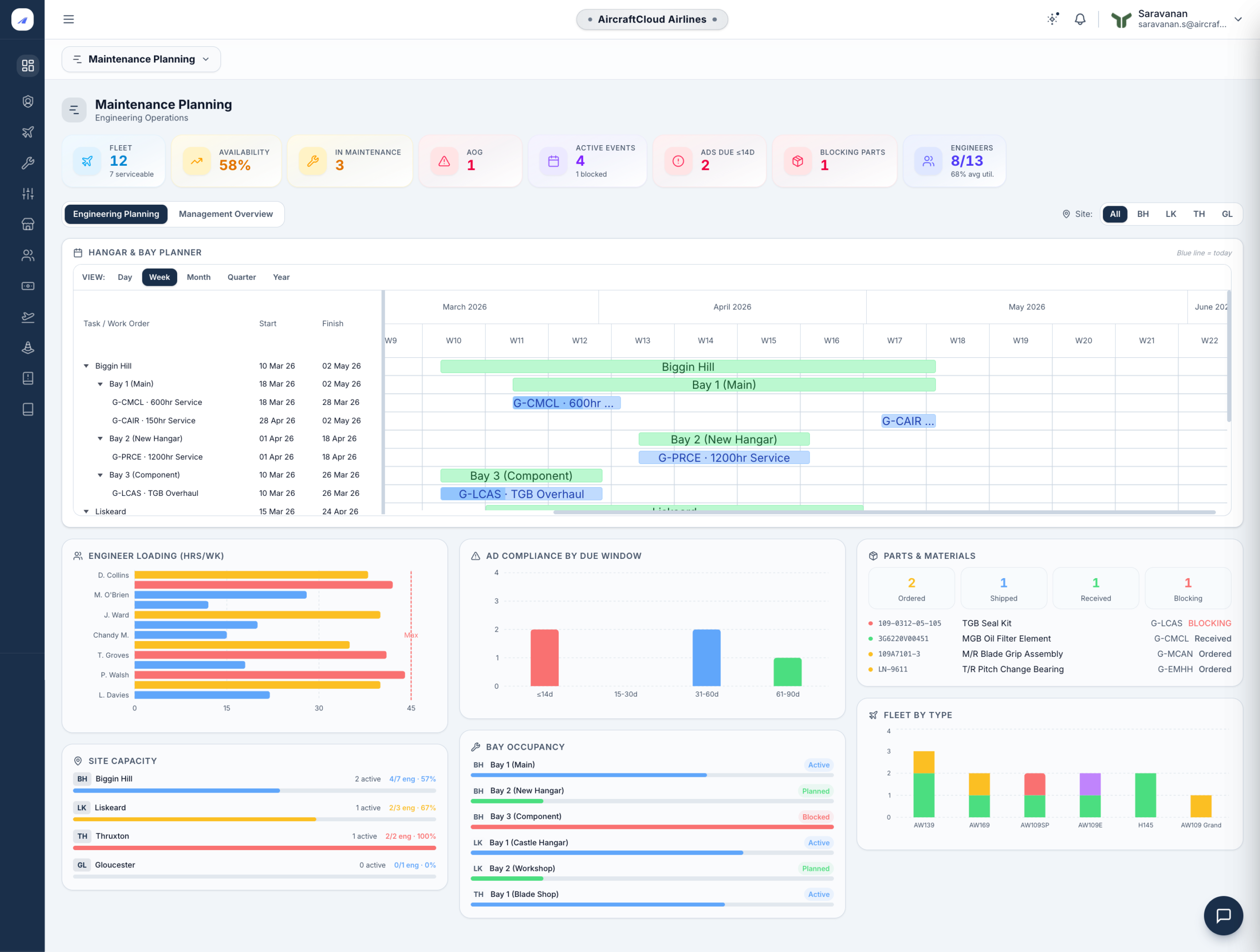
Allocate technicians and teams to specific checks or phases. Visualize current hangar operations with interactive, color-coded planning boards. Use “What-If” simulations to adjust staffing or schedules and assess the impact on timelines and resources.
Capacity Planning
Evaluate hangar-wide capacity with real-time comparison of available vs. scheduled work. Filter by skill, shift, or trade to detect constraints. Test scenarios such as overtime, additional shifts, or rescheduling with built-in “What-If” tools.
Non-Routine Management
Raise and manage non-routine findings with integrated approval workflows. Generate Non-Routine Cards (NRCs), route them for digital approvals, and incorporate them into the ongoing check plan.
Real-Time Visibility & Airline Collaboration
AircraftCloud offers a complete bird’s-eye view of all MRO operations-from task progress and material flow to team workloads and turnaround timelines. MROs can also provide airlines secure, permission-based access to view check status, approve non-routine tasks, and collaborate directly within the platform-enhancing transparency, reducing delays, and building trust.
Customer, Engineer, and Supervisor Interfaces
AircraftCloud provides role-specific boards to boost efficiency and transparency. The Customer Board offers real-time check progress and NRC approvals. The Engineer Board lets technicians update tasks, request parts, and print cards on the hangar floor. The Supervisor Board supports team management, approvals, and live progress monitoring.
Our Solution: AircraftCloud MRO Management
Smart MRO for Real Ops

Why AircraftCloud MRO?
Cloud-Native Advantage
Built for Real Aviation Teams
End-to-End Visibility
Easy Integration
Flexible Pricing Models
Frequently Asked Questions
What is MRO software and how does it work?
MRO (Maintenance, Repair and Overhaul) software helps maintenance organisations plan, run and bill aircraft maintenance in one system. AircraftCloud MRO covers the full check lifecycle: quotations, contracts, check planning, work orders, non-routine cards, parts and tools, technician rostering, capacity planning and invoicing. Teams work from live dashboards instead of spreadsheets and paper task cards.
How much does MRO software cost?
Pricing depends on the modules you need, your fleet or hangar size and your number of users. AircraftCloud offers flexible models, including SaaS subscriptions, pay-per-use and enterprise licensing, with no heavy upfront hardware or server investment. For an accurate figure, book a demo and we’ll scope pricing to your operation
What is the difference between cloud-based and on-premise MRO software?
On-premise MRO software runs on your own servers, so you manage the hardware, upgrades and IT maintenance. Cloud-native MRO software like AircraftCloud is hosted on Microsoft Azure, needs no local installation, updates without downtime and is accessible from the hangar floor on mobile devices. It also scales as you add aircraft, customers or hangar capacity.
How does MRO software help reduce aircraft turnaround time (TAT)?
Most TAT delays come from coordination: waiting on parts, approvals, staffing or information. AircraftCloud MRO links parts and tools to scheduled check phases, routes non-routine findings for digital customer approval, and shows real-time capacity against scheduled work. Supervisors can spot bottlenecks early and use “what-if” simulations to adjust shifts before delays build up.
What should I look for when choosing MRO software?
Look for end-to-end coverage from quote to invoice, digital NRC workflows, phase-based check planning, real-time capacity and rostering boards, mobile access for engineers, and secure customer collaboration. Check how well the system integrates with your CAMO, materials, quality and ERP tools, and whether the vendor supports phased rollout and data migration.
Is AircraftCloud MRO suitable for line, base, engine and component maintenance?
Yes. AircraftCloud is used by airline engineering departments, independent third-party MROs, line maintenance organisations and engine and component MROs. Check plan templates support recurring A, C and D checks as well as task-based programmes, and component-level tracking covers flight hours, cycles and calendar intervals.
How long does it take to implement MRO software?
Timelines depend on scope, data quality and how many modules you roll out. AircraftCloud supports phased implementation, module by module or aircraft by aircraft, so teams can go live in stages rather than all at once. A dedicated implementation manager guides setup, configuration, data migration and training.
Does AircraftCloud MRO integrate with ERP, finance and HR systems?
Yes. AircraftCloud provides APIs for real-time data exchange with external ERP, finance and HR systems, which avoids duplicate data entry. It also connects natively with AircraftCloud’s CAMO, Material Management and Safety & QMS modules for a single source of maintenance data.